
Best Software for Courier Businesses - 8 Tools to Help You Grow
There is a point in the life of most courier businesses when working harder stops being a particularly good growth strategy.
In the early days, almost everything can be managed manually. Jobs arrive by email or phone. Routes are planned with Google Maps. Drivers send messages when deliveries are complete. Invoices get raised at the end of the week and somebody keeps an increasingly complicated spreadsheet of vehicles, customers and outstanding payments.
It can work remarkably well.
Then the business grows.
Ten deliveries become 100. Two vans become 15. There are drivers to organise, vehicles to maintain, customers asking for updates, invoices to chase, new contracts to quote for and thousands of pounds tied up in equipment.
At that stage, software starts doing something much more important than saving a few minutes of administration. It creates capacity.
The best software for courier businesses allows the company to take on more customers, deliveries and drivers without creating the same increase in office work.
That does not mean buying every platform available. A good courier business technology stack should develop alongside the company itself. The important thing is identifying where growth is creating friction and finding software that removes it.
Here are eight types of software worth considering.
1. Spoke Dispatch: Last-Mile Delivery Management
For most courier businesses, delivery management software is the logical place to start.
After all, deliveries are the operation.
A growing courier company needs considerably more than an app that tells individual drivers which road to take next. Dispatchers need to divide work between drivers, optimise multi-stop routes, make changes during the day, monitor progress and know whether a delivery has actually been completed.This is where last mile delivery management becomes incredibly important.
Customers increasingly expect visibility too.
Spoke Dispatch brings those jobs together. It is designed for professional courier and delivery operations and includes multi-driver route optimisation, dispatching, live driver tracking, customer updates and proof of delivery.
The practical benefit is straightforward: a courier business can coordinate more work without requiring somebody in the office to manually manage every movement.
Routes can be planned centrally and assigned to drivers. Dispatchers can see progress during the day, while customers can receive more useful information about when their delivery is likely to arrive.
Efficiency improvements become particularly powerful at scale. Google Cloud's case study on Spoke reports that courier companies using Spoke alongside Google Maps Platform save an average of three hours per day, while drivers save an average of around an hour on their delivery rounds. Those are company-reported figures rather than a guarantee for every fleet, but they illustrate why routing efficiency matters once thousands of stops are involved.
For a courier company still organising routes through spreadsheets and phone calls, delivery management software can be one of the biggest operational upgrades available.
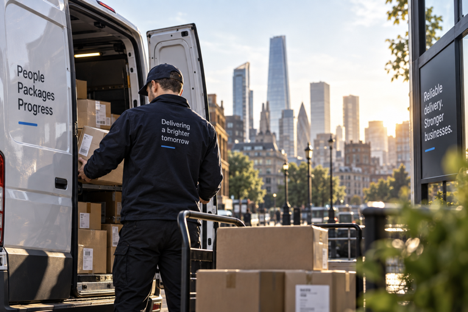
2. Samsara: Fleet Management and Telematics
Once a business owns more than a handful of vehicles, knowing where those vehicles are is only the beginning.
The bigger questions are usually more expensive.
How much fuel are they using? Which vehicles are idling excessively? Are drivers following planned routes? Is a mechanical fault developing? Are vehicles being used efficiently? Could maintenance be carried out before something breaks at the worst possible moment?
Samsara tackles this side of the operation.
Its fleet telematics platform combines real-time GPS location data with vehicle diagnostics, fuel information, driver and vehicle insights, routing tools and maintenance capabilities.
For courier businesses, there is an important distinction between delivery management and fleet management.
Spoke is primarily concerned with getting today's deliveries completed efficiently. Samsara goes deeper into what is happening with the physical fleet carrying them.
As the number of vans increases, relatively small inefficiencies become expensive. A little unnecessary idling across one vehicle is insignificant. Multiply it across 50 vehicles for an entire year and it becomes a line on the accounts worth paying attention to.
Telematics can also give management better information when deciding whether to repair, replace or redeploy vehicles.
A business with two vans probably does not need an elaborate fleet-management platform. A business with 20, 50 or 200 vehicles has a much stronger case.
3. Fleetio: Vehicle Maintenance Management
A courier business only makes money when its vehicles are available to work.
That makes maintenance one of those areas that can seem fairly simple with three or four vans and become surprisingly difficult once the fleet grows. Service dates are missed, minor defects turn into expensive repairs and nobody has a complete picture of what has been spent on a particular vehicle.
Fleetio is designed to bring that side of the operation under control.
The platform can manage preventive maintenance schedules, inspections, repair issues, service histories and digital work orders. Businesses can track parts and labour, set maintenance reminders based on mileage, time or vehicle usage, and keep records of work completed whether maintenance is handled internally or outsourced.
For courier companies, the real value is uptime.
A van sitting in a workshop is not completing deliveries. Catching maintenance requirements earlier, keeping servicing organised and having a clear history for each vehicle can reduce the chances of small problems becoming disruptive ones.
Fleetio also fits neatly alongside the other software in this list. Samsara can provide detailed information about what vehicles are doing on the road, while FinQuery deals with the accounting and financial treatment of the assets themselves. Fleetio occupies the operational space between them: keeping those vehicles maintained, documented and available for work.
4. FinQuery Fixed Assets: Managing Vehicles and Other Business Assets
There is a stage at which a courier company's asset register stops being a simple spreadsheet.
Vehicles are the obvious example, but they may only be part of it.
A larger operation can own vans, trucks, warehouse equipment, handheld scanners, IT equipment, machinery and other capital assets. Those assets are acquired at different times, depreciated over different periods, moved, modified and eventually sold or disposed of.
Keeping an accurate record becomes a genuine accounting responsibility.
This is where FinQuery Fixed Asset Software becomes interesting to established and growing businesses alike.
FinQuery's fixed asset accounting software is designed around the complete asset lifecycle. It supports areas including multi-book depreciation, parent-child asset structures, partial disposals, reporting and audit trails. FinQuery also allows leased and owned assets to be managed within its wider subledger platform.
For a courier company with a substantial vehicle fleet, that can solve a problem that ordinary bookkeeping software may eventually struggle with.
Take a growing delivery operation that regularly purchases vehicles.
Some may be owned outright. Others may be leased. Vehicles enter service at different times and are disposed of at different points. Equipment may be added or replaced. The finance team needs accurate depreciation schedules and records that can stand up to scrutiny.
FinQuery provides a more purpose-built environment for dealing with that complexity. Its fixed-assets product also supports detailed asset components and maintaining tax and financial books side by side.
This is not something a newly established courier with two vans needs to rush out and buy.
It becomes much more compelling when the company has accumulated enough valuable assets that maintaining them properly in spreadsheets is becoming an accounting risk in itself.
5. HubSpot CRM: Turning Enquiries Into Customers
Operational software helps you fulfil work.
A CRM helps you win it.
Courier companies sometimes neglect this side of growth because today's deliveries always feel more urgent than next month's sales pipeline.
That can leave a company surprisingly dependent on referrals, one or two large accounts or the owner's ability to remember every conversation they have had.
HubSpot CRM provides a more organised approach.
Businesses can use it to manage prospects and sales opportunities, keep track of deals and see where potential customers are within the sales pipeline. HubSpot offers pipeline-management functionality without requiring a business to build its own system from spreadsheets and inboxes.
Imagine a regional courier business trying to win more ecommerce clients.
One retailer requests prices today. Another wants to revisit the conversation in three months. A third is unhappy with its existing courier but has six months left on a contract.
Those conversations can be extremely valuable.
They are also very easy to forget.
A CRM turns sales follow-up into a process rather than relying on somebody's memory.
That becomes increasingly important if several people are responsible for bringing in business.
6. Deputy: Driver and Staff Scheduling
Drivers are another area where complexity increases sharply with growth.
Organising five people can be relatively informal.
Organising 50 means dealing with availability, holidays, sickness, shift swaps, overtime and changing demand without accidentally leaving the business short-staffed.
Deputy is designed for businesses that manage shift-based employees. Its platform covers employee scheduling, time and attendance, leave management and shift changes, while managers can monitor attendance and timesheets from a central system.
That can work well for courier businesses employing drivers, warehouse workers and dispatch teams across different shifts.
It is particularly useful when delivery volumes are uneven.
Monday morning may require considerably more staff than Wednesday afternoon. Christmas may look nothing like February. A new contract might suddenly create demand for an additional evening shift.
Workforce software makes it easier to match people to those requirements rather than endlessly rebuilding rotas manually.
It also gives employees a more organised way to handle availability and leave instead of relying on text messages and scraps of paper.
7. Zendesk: Customer-Service Management
Delivery businesses generate customer enquiries almost by design.
Where is my parcel?
Can I change the address?
The tracking says delivered, but where was it left?
Can you send me proof of delivery?
Can tomorrow's collection be moved to the afternoon?
When a small company receives a handful of these questions, a shared email inbox may be perfectly adequate.
The problem starts when several employees are dealing with customers across email, phone, messaging and other channels.
Zendesk is built to organise customer support around tickets, giving teams a central place to track and resolve enquiries. Its Agent Workspace can bring conversations across channels into the same ticket interface rather than requiring staff to constantly jump between systems.
For a growing courier business, that can prevent a familiar problem: two employees answering the same customer while another customer's issue is missed entirely.
There is a secondary benefit too.
Once enquiries are properly recorded, they become data.
If 40 customers contact the company about the same type of delivery problem, management can see a pattern. Perhaps notification wording is unclear. Perhaps one route consistently runs late. Perhaps a particular client is supplying bad addresses.
Customer service stops being purely reactive and starts providing useful operational information.
8. Zapier: Connecting Your Software Together
At some point, a growing business encounters an unexpected technology problem.
It has too much software.
The CRM contains one set of information. Accounting has another. Delivery jobs live somewhere else. Customer enquiries are in the support system. Employees repeatedly copy the same names, addresses and order numbers between applications.
Automation can remove some of this duplication.
Zapier connects applications and allows businesses to create workflows in which an event in one system triggers an action elsewhere. Zapier says its platform now supports more than 9,000 applications.
The applications themselves are less important than the principle.
A website enquiry could automatically create a CRM record.
A particular form submission could notify the relevant employee.
Information entered in one business system could trigger work in another without somebody remembering to copy it manually.
Individually, these automations can look trivial.
That is why they are so easily overlooked.
Saving two minutes is irrelevant if something happens once a year. Saving two minutes on a task performed 100 times every working day is very different.
Build Your Software Stack Around Bottlenecks
A courier company does not become sophisticated because it pays for lots of software.
In fact, buying too many systems too early can create its own problems.
The better approach is to look for bottlenecks.
If drivers are wasting time and dispatch has become chaotic, look at delivery management first.
If vehicle costs are difficult to control, fleet telematics may deserve attention.
If cash is disappearing despite strong sales, accounting and financial reporting need work.
If the company now owns a substantial fleet and the finance team is struggling to maintain an accurate asset register, fixed asset accounting software such as FinQuery starts to make considerably more sense.
If leads are being forgotten, introduce a CRM.
The technology should follow the operational problem, not the other way around.
Good Software Makes Growth Less Expensive
The best way to think about courier software is not in terms of features.
Think about leverage.
A good dispatch system allows the same operations team to coordinate more deliveries.
Better routing allows the same drivers and vehicles to complete more work.
Fleet-management software helps protect one of the company's biggest investments.
Accounting software gives management a clearer picture of whether the operation is actually making money.
FinQuery can help a larger courier business maintain proper financial control over a growing base of vehicles and other fixed assets.
A CRM gives salespeople a repeatable process for bringing in new accounts.
Workforce software makes a growing team easier to organise.
Customer-service software allows support to scale without every enquiry disappearing into somebody's inbox.
Automation removes small administrative jobs altogether.
That is what good software should do for a growing courier business.
It should not make the company feel more technical. It should make the company easier to run.
There will always be another delivery to complete, another van to maintain and another customer to answer. Growth inevitably creates complexity.
The businesses that handle it well are usually not the ones whose owners simply work longer hours.
They are the ones that gradually turn the things they once managed from memory into systems.
And that is ultimately what the best software for courier businesses provides: systems that keep working as the business gets bigger.